
Industrial O-Rings for Equipment, Assemblies, and Precision Sealing
Standard sizes. Application-specific compounds. Custom options when the fit matters.
Finn Global Supply helps OEMs, distributors, and maintenance teams source industrial O-rings for new equipment, production assemblies, and replacement parts. We work with standard rubber O-rings, custom O-rings, and micro O-rings, with material and dimensional requirements matched to the application.
Whether you’re replacing O-ring seals in a hydraulic assembly or specifying a miniature seal for a new design, start with the details that determine fit and performance. Send FGS a part number, drawing, or operating specification. We’ll review your requirements and discuss material options, pricing, and availability.
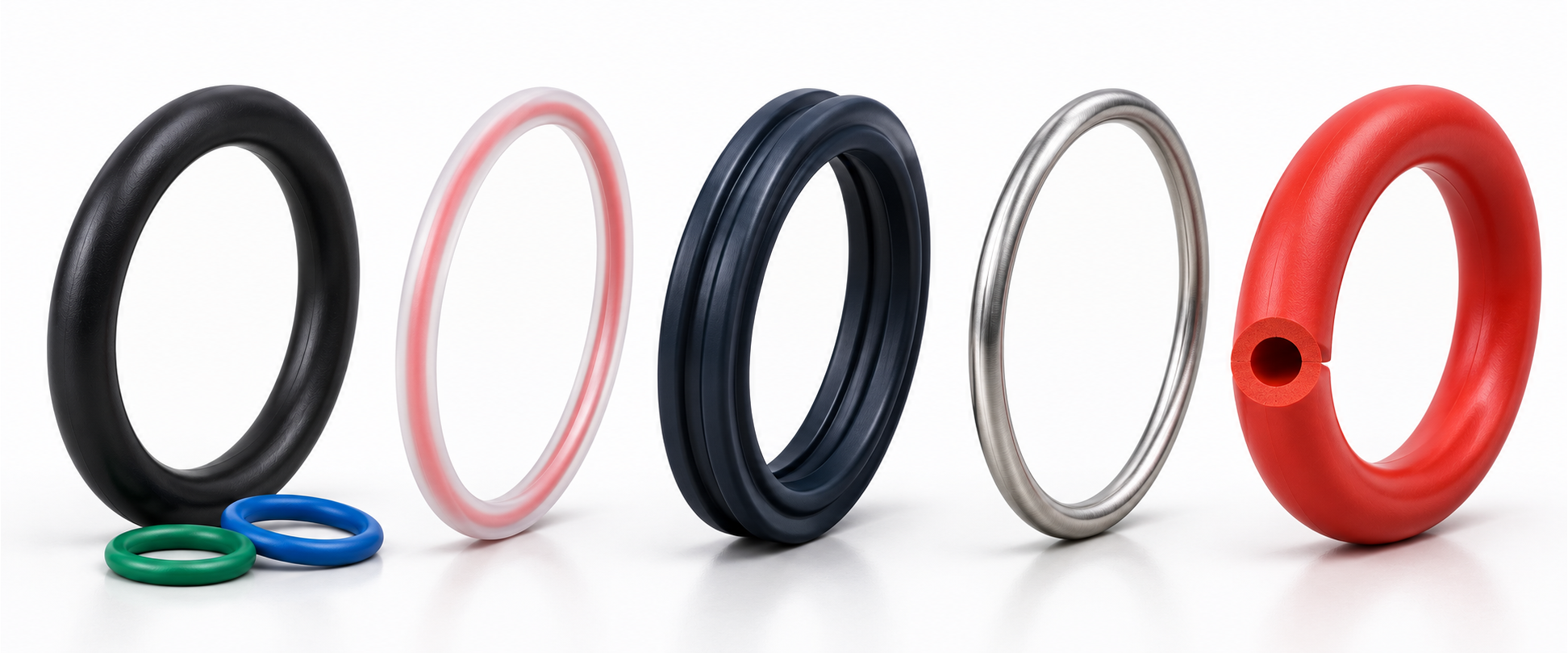
Industrial O-Rings: What Determines a Good Seal?
An O-ring is a circular seal with a round cross-section. In a typical assembly, it sits in a groove, also called a gland. As the mating parts come together, they compress the ring to establish contact with the sealing surfaces. The groove dimensions, clearance, and condition of those surfaces all affect how the seal performs.
Two rings can look identical and still behave differently in service. A ring made from a softer compound may compress differently from a harder ring of the same size. An elastomer that performs well in one oil may swell or lose strength in another fluid. Likewise, a ring that works in a stationary cover may wear quickly in a moving assembly.
For purchasing teams, this means a description such as “black rubber ring” leaves too much open. A useful specification includes the dimensions, compound, hardness, and any documentation the application requires. For engineering teams, add the groove drawing and service conditions so the part can be reviewed in context.
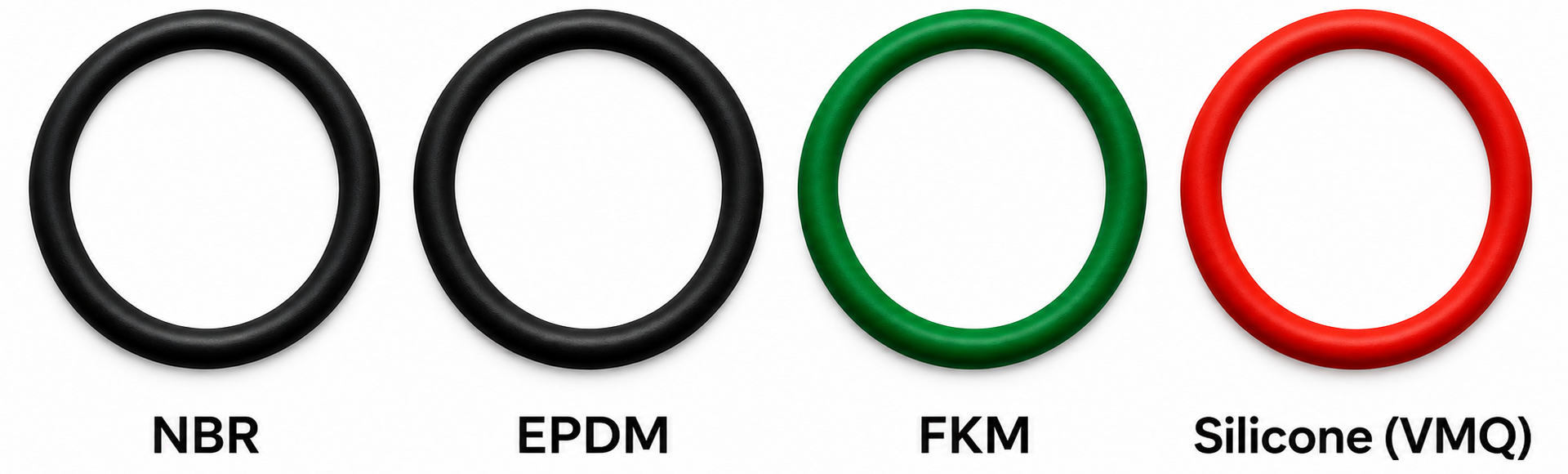
Rubber O-Rings: Compare Materials by Application
Start with what touches the seal. Include the process fluid, lubricants, cleaning agents, and anything the ring sees during startup, shutdown, or maintenance. Then consider temperature, pressure, motion, and service life.
Use this table to narrow the discussion. The properties below are general characteristics; the exact compound determines the limits for a particular part.
| O-Ring Material | Typical Selection Considerations |
|---|---|
| Nitrile / NBR | A common starting point for petroleum oils, lubricants, and compatible hydraulic fluids. |
| EPDM | Often considered for water, outdoor exposure, and ozone. Generally unsuitable for petroleum oils and fuels. |
| FKM | Consider for elevated temperatures and exposure to many oils, fuels, and chemicals. Check the specific grade for low-temperature service. |
| Silicone / VMQ | Retains flexibility across a broad temperature range. Review tear and abrasion requirements, particularly where the seal moves. |
| Hydrogenated Nitrile / HNBR | Offers oil resistance with improved heat and mechanical performance compared with conventional nitrile. |
| Perfluoroelastomer / FFKM | Consider for demanding chemical or thermal service where conventional elastomers fall short. |
| Fluorosilicone / FVMQ | An option where fuel exposure and flexibility in cold conditions are both important. |
| Neoprene / CR | Offers a balance of weathering resistance and resistance to certain oils. |
| Polyurethane / AU or EU | Consider where abrasion resistance and mechanical strength are priorities. Review the grade against fluid and moisture exposure. |
| Butyl / IIR | An option when low gas permeability is an important part of the specification. |
| FEPM | A specialty elastomer worth evaluating for selected steam, hot-water, and chemical applications. |
Material selection often comes down to the most demanding part of the service cycle. For example, a seal might tolerate the process fluid at normal operating temperature but also need to withstand a different cleaning chemical at a higher temperature. Include both conditions when requesting a material review.
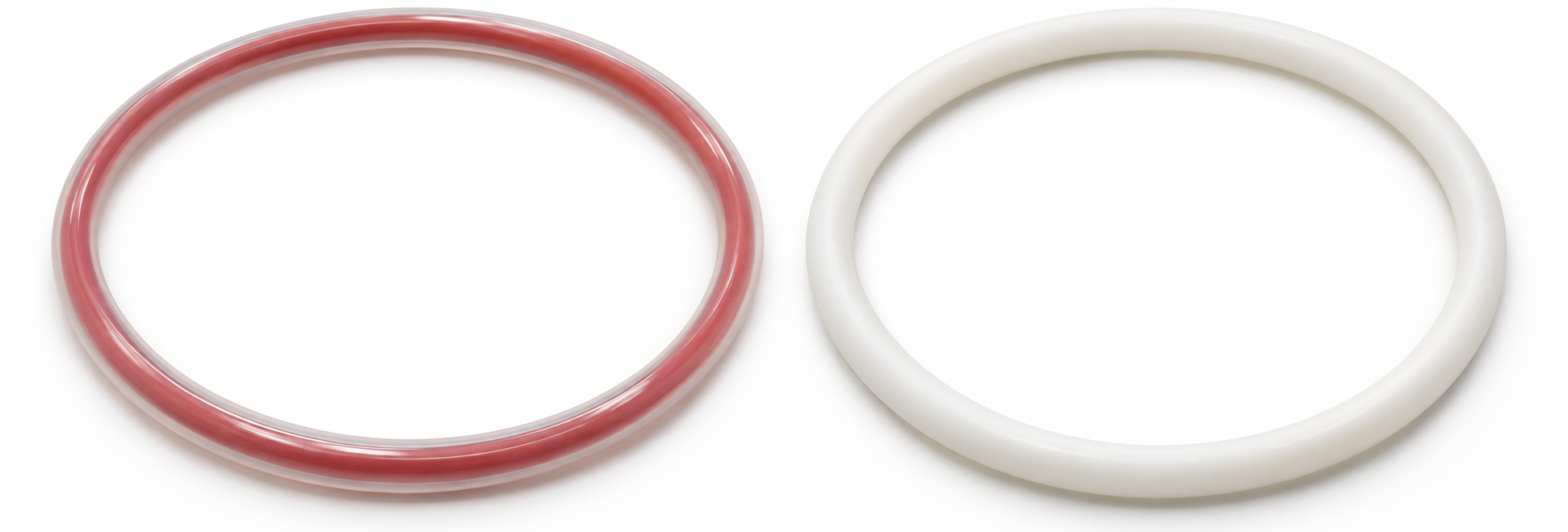
Specialty O-Ring Seals: Construction, Surface Finish, and Performance
Material is only one part of the specification. The ring’s construction or surface treatment may also affect how it installs and performs. Discuss these options with Finn when a standard molded ring doesn’t meet your requirements.
| Type | When to Discuss It with Finn |
|---|---|
| Low-Temperature FKM O-Rings | The application calls for fluorocarbon performance and improved flexibility in cold conditions. |
| FEP- or PFA-Encapsulated O-Rings | A fluoropolymer jacket over an elastomer core is being considered for chemical exposure, typically in static service. |
| Solid PTFE O-Rings | A fluoropolymer ring is specified, and the gland can accommodate its lower elastic recovery and different installation behavior. |
| Metal-Detectable O-Rings | The plant uses metal detection as part of its contamination control process and needs a suitable, documented compound. |
| Rapid Gas Decompression-Resistant O-Rings | A pressurized gas system can depressurize quickly. Specify any required qualification and test conditions. |
| Coated or Lubricated O-Rings | Assembly friction, sticking, or handling is a concern. Identify the permitted coating or lubricant and any cleanliness restrictions. |
Encapsulated and solid PTFE rings have different constructions. An encapsulated ring has a jacket and a resilient core. A solid PTFE ring has no elastomer core. Even when both options appear suitable for the process fluid, differences in installation stretch and recovery can affect whether either ring fits the existing gland.
X-rings and back-up rings are also worth distinguishing. An X-ring, sometimes called a quad ring, has a four-lobed profile. A back-up ring supports a seal against extrusion in a suitable groove. If the drawing calls for either, include it in the inquiry so the complete sealing arrangement can be reviewed.
Industrial O-Ring Sizes: AS568, Metric, and International Standards
Two measurements identify the nominal size of most O-rings: the inside diameter (ID) and the cross-section (CS). The cross-section is the thickness of the round sealing profile. Outside diameter is useful as a cross-check, but it can’t uniquely identify the size without another dimension.
| Size System | What to Include in Your Inquiry |
|---|---|
| AS568 | The dash number, such as AS568-214, plus the material and hardness. The dash number identifies the size; it does not specify the compound. |
| Metric | Inside diameter × cross-section in millimeters. For example, 25 × 2 mm means 25 mm ID and 2 mm cross-section. |
| ISO 3601 | The referenced part or size designation and any applicable dimensional or quality requirements on the drawing. |
| BS 1806 | The British size reference if it appears on a legacy drawing or equipment specification. |
| JIS B 2401 | The complete Japanese standard designation, including the series and size where specified. |
| SMS 1586 | The Swedish size reference if it appears in the original equipment documentation. |
| Drawing-Defined Sizes | Nominal inside diameter and cross-section, tolerances, units, and drawing revision. Include any inspection criteria that affect acceptance. |
A metric ring and an inch-size ring can be close enough to look interchangeable. Before substituting, compare the actual dimensions and tolerances. A small difference in cross-section can change how much the ring compresses, especially in a small gland.
If all you have is a used ring, send its approximate measurements along with the equipment model and installation location. A used ring may have stretched, flattened, or changed size in contact with fluid. The original part number, an unused sample, or the groove drawing is usually a better reference.
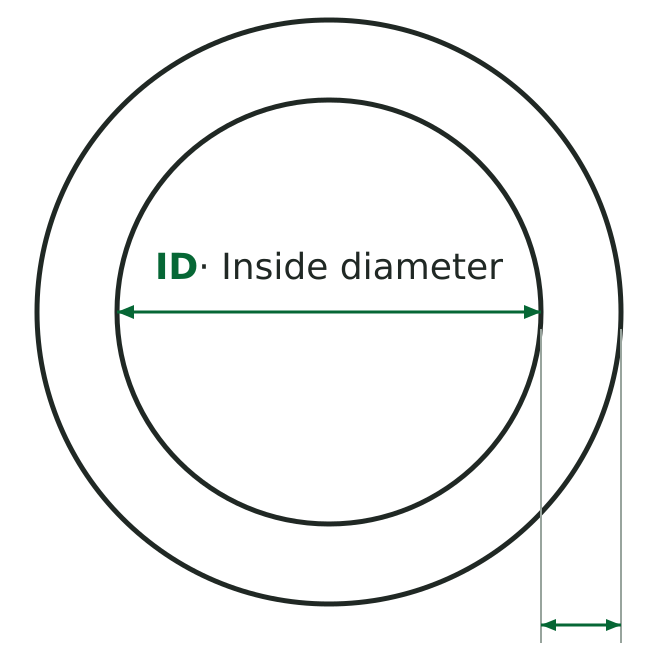
CS - Cross Section
O-Ring Colors and Hardness: What to Put on the Drawing
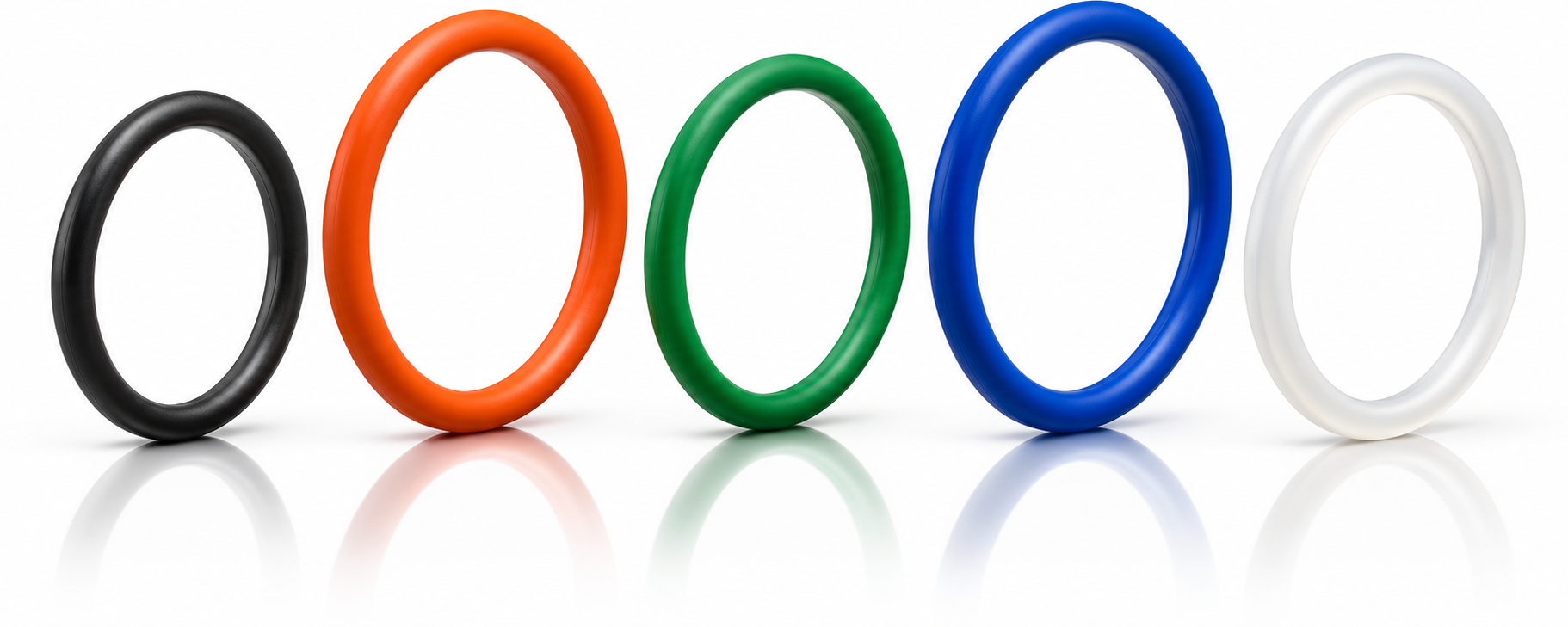
Color is useful for visual identification on an assembly line, in a service kit, or during inspection. It can help operators distinguish similar-looking parts or spot a small seal against surrounding hardware. However, there is no universal color code that identifies O-ring materials across suppliers.
| Color or Appearance | Practical Reason to Specify It |
|---|---|
| Black | A common industrial appearance. Use the compound code or packaging label to identify the material. |
| Red or Orange | Provides visual contrast or helps distinguish a part in an assembly. |
| Green or Brown | Can support an internal part identification scheme when the color is tied to an approved specification. |
| Blue | Can improve visibility in selected applications. If detection is required, specify the detectable compound separately. |
| White or Translucent | May be preferred for visual inspection or appearance. Confirm availability in the required compound. |
For production orders, tell us whether color is an exact requirement or a preference. If the color must match an approved part, supply a reference sample or the drawing requirement. Keep the material specification and part number on the order so the color can’t be mistaken for proof of compatibility, detectability, or compliance.
Hardness is a separate requirement. Rubber O-rings are commonly specified in Shore A, with values such as 70 Shore A or 90 Shore A appearing on drawings. A harder ring may help address extrusion in some designs, while a softer ring may conform more readily under limited compression. Neither choice can be made from pressure alone. The gland clearance, temperature, compound, and assembly conditions also matter.
Micro O-Rings for Small Components and Tight Spaces
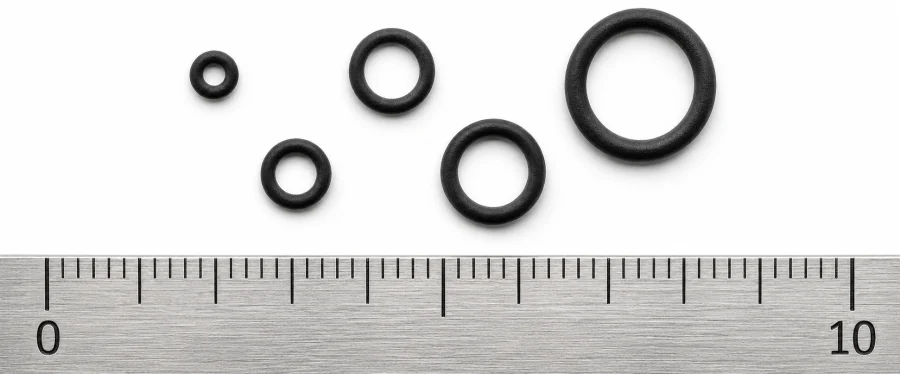
Micro O-rings seal compact assemblies where a conventional ring is too large. Examples include miniature valves, instrumentation, compact fluid connections, and electrical connector assemblies. At this scale, dimensional variation that might be minor in a larger seal can affect how the ring seats and compresses.
Finn’s micro and miniature O-ring capabilities cover precision sealing requirements for compact designs. For a new inquiry, send the drawing with nominal dimensions and tolerances, plus the compound and hardness if already specified.
It also helps to describe how the ring will be installed. A part fitted by hand may need different handling and presentation from a part fed into automated equipment. If the assembly requires clean handling, individual packaging, or a particular inspection method, include that information before quoting. These details can affect the supply format even when the part dimensions stay the same.
Custom O-Rings: Molded or Spliced?
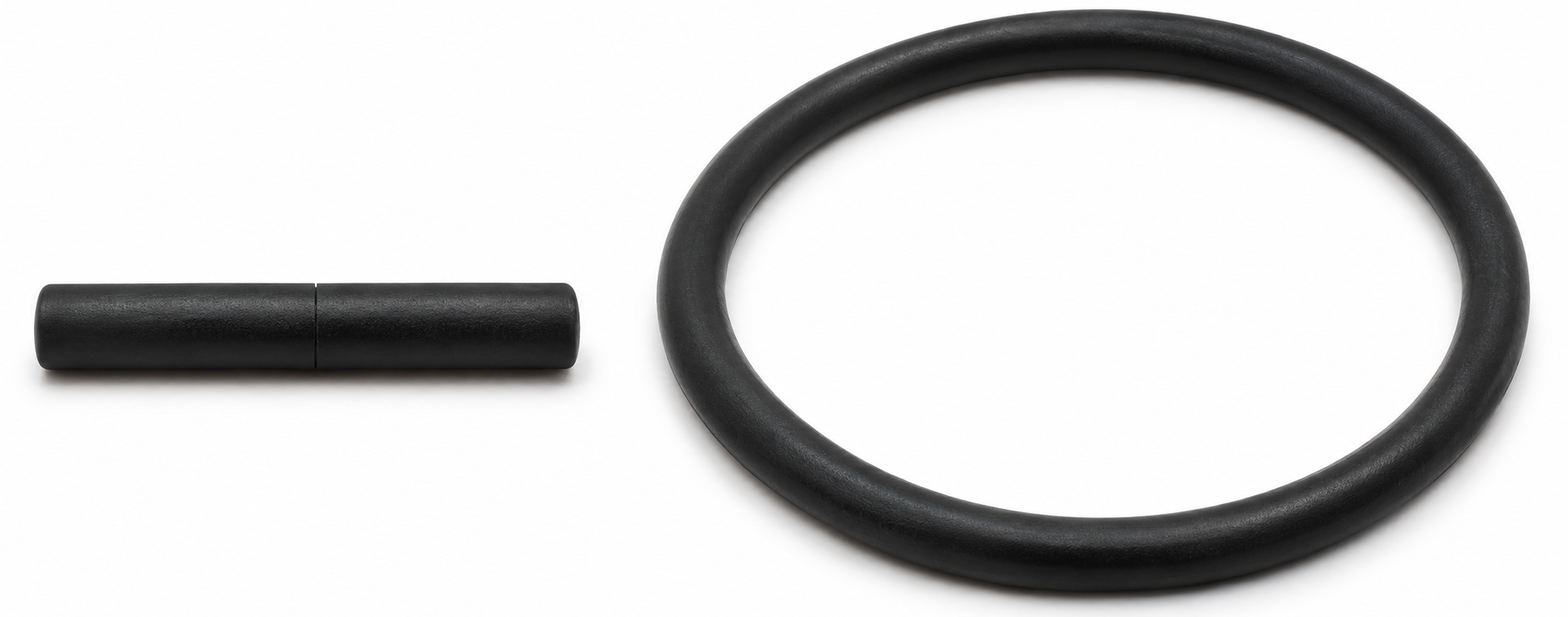
Custom O-rings may be needed when a standard part cannot meet the required diameter, cross-section, material, or tolerance. Start with the groove and service conditions. That helps establish whether the part calls for a molded ring, a spliced ring, or another sealing profile.
Custom molded rings are worth discussing when the application calls for a continuous molded part, specific dimensional control, or a defined production requirement. Provide the part drawing, tolerances, expected volume, and any approval process so the quote can account for tooling and inspection where applicable.
Spliced O-rings are made by joining elastomer cord to form a ring. They can be a practical route for some large diameters and nonstandard sizes, particularly when a suitable standard molded size is unavailable. The joint matters: review its suitability for the application before treating a spliced ring as equivalent to a molded part.
For a large cover, housing, or other custom assembly, send Finn the required diameter, cord cross-section, and operating conditions. See our O-ring splicing services for more on this option.
Static and Dynamic O-Ring Seals
In a static seal, the mating surfaces remain stationary relative to one another during normal operation. Examples include a flange, cover, fitting, or housing. The seal still needs enough compression to establish contact and sufficient support to accommodate the operating pressure and clearance.
In a dynamic seal, one surface moves relative to the other. Reciprocating rods and pistons, for example, put different demands on a ring than a static cover. Surface finish, motion, lubrication, and wear deserve particular attention. A standard O-ring may be suitable for some moving assemblies, while others call for a different profile.
For either arrangement, describe what happens in service. If a rod cycles intermittently, include the stroke and frequency if known. If pressure reverses, temperatures cycle, or the unit is cleaned between runs, note that too. These details help us understand the requirements the replacement seal must meet.
O-Ring Selection for OEM, Maintenance, and Distributor Orders
For an OEM design, start with the drawing and the conditions the equipment will see in operation. Identify any fixed requirements early, such as an approved material, assembly lubricant, color, or packaging format. If the material is open, describe the environment so we can discuss which options merit evaluation.
For maintenance and replacement, share the original part number or equipment model. If the old ring failed, tell us what you observed: swelling, flattening, cracking, or wear. These observations can help guide the review, but they don’t establish the cause by themselves. A recent change in fluid, cleaning procedure, or operating temperature may be just as relevant as the part dimensions.
For distributor and repeat orders, specify the exact grade or approved part reference, order quantities, and delivery schedule. If substitutions require approval, say so up front. It’s easier to compare quotations when each supplier is working from the same drawing revision and documentation requirements.
For regulated or controlled applications, list the actual requirement. A food processing line, a drinking water system, and a medical equipment assembly can call for different documentation. Request the applicable test records, declarations, or lot traceability for the exact compound and part being quoted.
O-Ring FAQs
• Can I order by dash number alone?
A dash number is a useful starting point for identifying the size. For a complete quote, add the compound, hardness, and quantity. If a drawing calls for a particular material specification or certification, include that reference too.
• Can Finn review a part if I only have a sample?
Yes. Start by sending a photo, approximate dimensions, and the equipment or assembly reference. Let us know whether the sample is new or used. If it’s worn or deformed, any available drawing or part number will help establish the original specification.
• Can I match an O-ring by color?
Use color as a visual aid when it’s part of your documented identification system. To match the part itself, confirm the size, compound, hardness, and applicable part specification.
• Can I use a harder O-ring to solve a leak?
A harder ring may be appropriate in some applications, but a leak can also come from incorrect dimensions, surface damage, fluid incompatibility, or a change in operating conditions. Share the gland details and what changed before specifying a replacement.
Request Industrial O-Ring Pricing and Availability
Send us your part number or drawing. We’ll review the requirements and quote the options we can supply.
For a standard part, start with the size, compound, hardness, and quantity. For custom O-rings or specialty O-ring seals, include your drawing and a short description of the application.
- Dimensions: Dash number or inside diameter × cross-section, with units and tolerances.
- Material: Compound, Shore A hardness, and any color or surface treatment requirements.
- Service conditions: Temperature range, pressure, media, and whether the seal moves.
- Order details: Prototype or production quantity, requested delivery date, and required documentation.
If you don’t have all the details, send what you have. An existing part number, equipment reference, or drawing gives Finn a place to start.